New Study in JNCCN Unlocks Important Information About How to Treat Recurring Prostate Cancer
PR Newswire
PLYMOUTH MEETING, Pa., Feb. 9, 2026
UCLA researchers found that routine PSMA PET/CT scans could help doctors select treatment approaches for the best long-term outcomes in patients with recurring prostate cancer after surgical removal of the prostate.
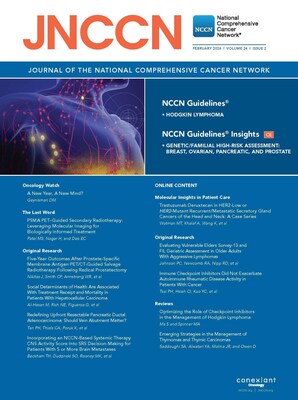
PLYMOUTH MEETING, Pa., Feb. 9, 2026 /PRNewswire/ -- New research in the February 2026 issue of JNCCN—Journal of the National Comprehensive Cancer Network found that incorporating information from prostate-specific membrane antigen (PSMA) PET/CT scans may be able to predict progression-free survival (PFS) and guide treatment planning in patients with rising prostate-specific antigen (PSA) levels following removal of the prostate.
The researchers used retrospective clinical data from 113 patients treated for prostate cancer at University of California Los Angeles (UCLA) Jonsson Comprehensive Cancer Center. All were staged with PSMA PET/CT scans for recurrent disease.
According to exploratory analysis, patients who showed no visible disease on the scans (T0N0M0) had the most favorable PFS, and whole-pelvis radiotherapy (WPRT) had no significant benefit compared to prostate bed radiotherapy alone. However, WPRT did significantly improve PFS for patients with local, visible disease (TrN0M0). For patients with nodal or distant metastatic disease visible on the scans, androgen deprivation therapy (ADT) was significantly associated with improved PFS. Thus, PSMA PET/CT scans may help better tailor therapy for recurrence in this patient population.
"This research highlights the importance of facilitating routine PSMA PET/CT scans in patients with a biochemical recurrence of prostate cancer after surgery to remove the prostate gland," said Lead Researcher John Nikitas, MD, UCLA Jonsson Comprehensive Cancer Center. "The information from these scans is strongly associated with long-term outcomes and frequently changes treatment recommendations. We found that other measures, like PSA levels, were not strongly associated with long-term response to secondary/salvage therapy."
The researchers noted that by using PET/CT scans, they may be able to tailor therapies to not only achieve better results but also to reduce side-effects by avoiding any treatments that are less likely to be effective.
"PSMA PET imaging lets us move from one-size-fits-all radiation therapy in the secondary/salvage setting to treatment that's guided by the anatomy, and perhaps by extension, the actual biology of a patient's prostate cancer," commented E. Christopher Dee, MD, Memorial Sloan Kettering Cancer Center, who was not involved in this research. "This study shows that seeing where the cancer is, even at low PSA levels, may meaningfully shape treatment decisions and could potentially influence long-term outcomes. It's a step forward in making prostate cancer care more precise and effective and can inform future prospective research in the secondary/salvage radiation space."
Dr. Dee wrote a longer commentary on the study that is also featured in the February 2026 issue of JNCCN. To read the entire study "Five-Year Outcomes After Prostate-Specific Membrane Antigen PET/CT-Guided Salvage Radiotherapy Following Radical Prostatectomy" and the corresponding "The Last Word" commentary, visit JNCCN.org.
About JNCCN—Journal of the National Comprehensive Cancer Network
More than 22,500 oncologists and other cancer care professionals across the United States read JNCCN—Journal of the National Comprehensive Cancer Network. This peer-reviewed, indexed medical journal provides the latest information about innovation in translational medicine, and scientific studies related to oncology health services research, including quality care and value, bioethics, comparative and cost effectiveness, public policy, and interventional research on supportive care and survivorship. JNCCN features updates on the NCCN Clinical Practice Guidelines in Oncology (NCCN Guidelines®), review articles elaborating on guidelines recommendations, health services research, and case reports highlighting molecular insights in patient care. JNCCN is published by Conexiant. Visit JNCCN.org for more information.
About the National Comprehensive Cancer Network
The National Comprehensive Cancer Network® (NCCN®) is a not-for-profit alliance of leading cancer centers devoted to patient care, research, and education. NCCN is dedicated to defining and advancing quality, effective, equitable, and accessible cancer care and prevention so all people can live better lives. The NCCN Clinical Practice Guidelines in Oncology (NCCN Guidelines®) provide transparent, evidence-based, expert consensus-driven recommendations for cancer treatment, prevention, and supportive services; they are the recognized standard for clinical direction and policy in cancer management and the most thorough and frequently-updated clinical practice guidelines available in any area of medicine. The NCCN Guidelines for Patients® provide expert cancer treatment information to inform and empower patients and caregivers, through support from the NCCN Foundation®. NCCN also advances continuing education, global initiatives, policy, and research collaboration and publication in oncology. Visit NCCN.org for more information.
Media Contact:
Rachel Darwin
267-622-6624
darwin@nccn.org

 View original content to download multimedia:https://www.prnewswire.com/news-releases/new-study-in-jnccn-unlocks-important-information-about-how-to-treat-recurring-prostate-cancer-302682612.html
SOURCE National Comprehensive Cancer Network